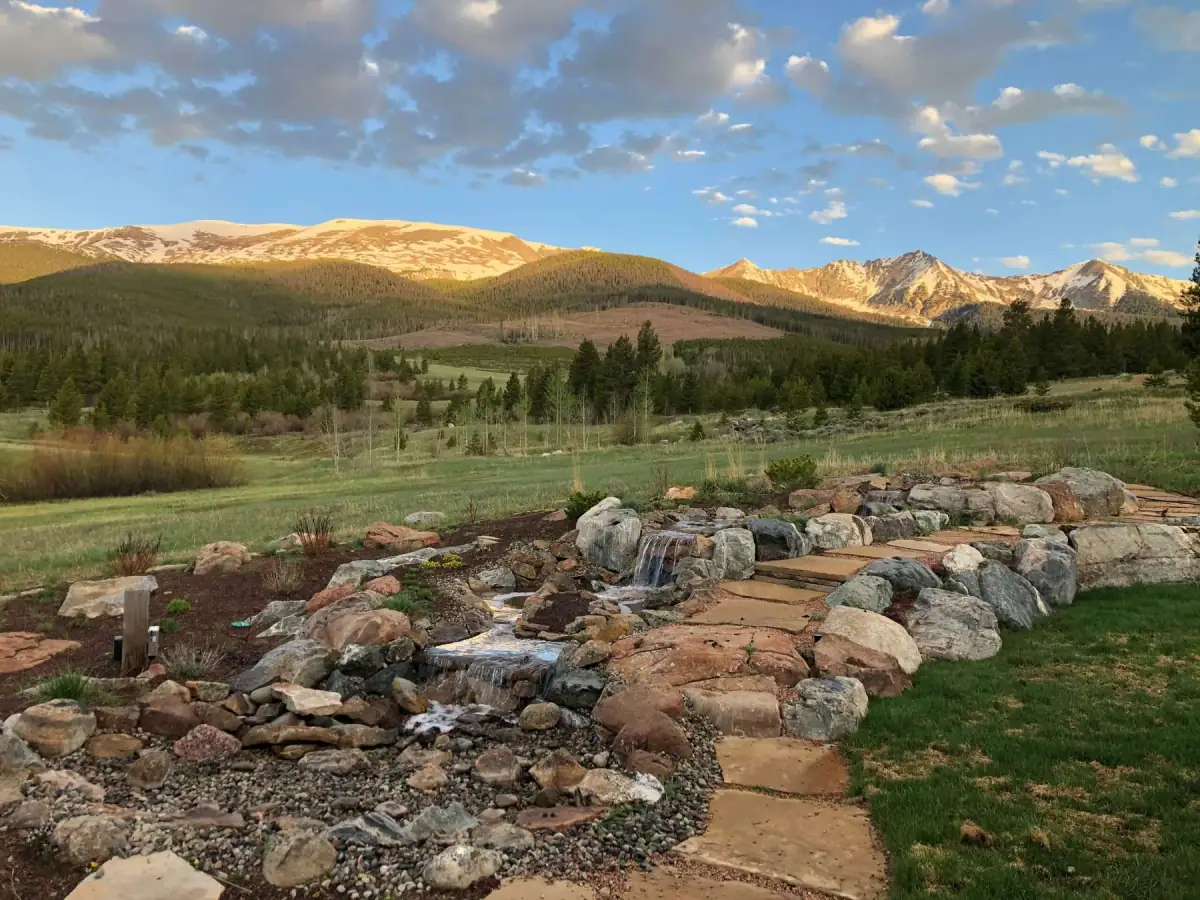
A water feature is usually selected from its summer appearance. The homeowner pictures the sound from the patio, reflections near the garden, or water moving through stone beside a walkway. At elevation, the feature also has a winter life. Snow covers portions of it. Ice forms. Access becomes harder. Pumps, plumbing, basins, stone, and overflow routes still have to remain part of the property after the outdoor furniture is stored.
Neils Lunceford builds ponds, waterfalls, and pondless water features across Summit and Grand counties as part of our landscape construction service. We plan high-country installations around freeze-thaw cycles, snow loads, strong ultraviolet exposure, slope, drainage, and mountain-site access. The first design question should be how the feature will be managed after the growing season ends.
A pond creates a visible body of water
A pond can support reflection, aquatic planting, fish where the design and owner commitment fit, and a more natural garden experience. It also creates a year-round water area that the homeowner has to understand. Before we draw the basin, we talk through depth, liner or structural system, water source, overflow, pump and filtration, planting, wildlife, edge treatment, winter operation, snow and ice, access, and ongoing care.
The homeowner should decide how much living water management is actually desired. A pond is not simply a large decorative bowl that disappears from the maintenance calendar after installation. Our design process produces detailed plans so those decisions show up in the construction record rather than only in the summer rendering.
A waterfall can exist with or without a large pond
The main goal may be sound and moving water rather than a visible pool. A waterfall can connect to a pond or recirculate through another basin arrangement. Before we develop the concept, we identify desired sound level, viewing angle, height change, existing slope, patio distance, bedroom or neighbor proximity, stone style, splash, wind, pump access, winter appearance, and the planned operating season.
A taller fall does not automatically create a better result. The sound may become too strong near a dining area or disappear under wind and road noise. Visit the proposed location during ordinary conditions rather than judging sound only from an online video. Examples of finished mountain work appear in our portfolio.
A pondless feature hides the reservoir
A pondless feature recirculates water through a concealed basin instead of leaving a large open pond visible at the bottom. That can fit a homeowner who wants moving water and sound without making a pond the center of the garden. The design still needs a reservoir, pump, plumbing, access, overflow, stone, grade, electrical supply, winterization, cleaning, make-up water, and drainage.
“Pondless” does not mean equipment-free or maintenance-free. It means the visible water returns into a concealed storage area. The equipment still has to be reachable after the surrounding planting fills in.
Decide the operating season
The owner and our team should agree on how the feature is expected to operate during colder conditions. When is the system normally shut down? Which components are removed or protected? Is water drained from any pipe? Does part of the feature retain water? Who performs startup and winterization? What happens during an early freeze, and what remains visible under snow?
The exact winter process depends on the design and equipment. It should be explained before the homeowner approves a feature based entirely on the summer look. Properties that also use our garden maintenance or irrigation crews can fold those seasonal handoffs into the same service calendar.
Snow storage can damage a poorly placed feature
Our recent article on planning summer landscapes around winter snow storage explained why landscape design should reserve areas for snow. A water feature needs the same coordination. Do not place vulnerable equipment where plows stack snow, roof snow releases, walkway clearing deposits material, or service access disappears. Heavy snow can load small stonework. Spring runoff can cross the basin. Driveway gravel can enter the feature.
Mark the water-feature area on the snow-removal plan. The plow operator, caretaker, and landscape team should know where concealed basins, controls, and fragile edges are located. When we also handle snow removal, those locations can be written into the winter route instead of discovered after the first storm.
Water supply and evaporation need a plan
Moving water can lose volume through evaporation, splash, wind, and ordinary operation. At high elevation, strong sun and dry air can affect the feature differently from a shaded low-elevation garden. Ask how the initial fill is completed, how water is added later, whether automatic make-up water is proposed, what happens if the level drops, how overflow is handled, who monitors a second home, and what alert or shutdown protection is included.
A seasonal homeowner should not assume the feature can run unattended for weeks without someone checking water level and equipment. That is especially true for vacation homes around Breckenridge, Silverthorne, and Granby.
The feature should fit the caretaker arrangement
Summit and Grand County properties are often second homes, rentals, HOA-managed units, or resort-adjacent properties. Identify who will check water level, remove debris, observe pump operation, report leaks, start and shut down the system, protect it during construction, and keep snow crews informed.
We provide design, construction, garden maintenance, irrigation, plant health care, and snow service under one operation. That can simplify the handoff, but the approved service scope still needs to state which team owns each task. The full menu sits under services.
Nearby planting, access, and budget
Nearby trees and shrubs create the finished setting, but they also drop leaves, needles, and mulch into the water. Ask the designer to balance seasonal color with access to equipment. A dense planting that hides the basin beautifully may also make every service visit difficult.
The homeowner should not have to drain the feature to reach a normal service component. The construction plan should identify the electrical route, pump location, filter access, basin access, shutoff, drain, and overflow. Those details belong on the same plan set we use for phased construction work.
The complete project can involve excavation, stone, pump and plumbing, electrical work, planting, irrigation changes, drainage, lighting, startup, winterization, and ongoing maintenance. Ask us to separate the core feature from the surrounding landscape scope so premium stone or planting does not crowd out the infrastructure the feature needs.
Save the design plan, equipment list, startup and winter instructions, basin location, service contacts, and photographs before concealment. We serve Breckenridge, Silverthorne, Frisco, Dillon, Keystone, Copper Mountain, Blue River, Granby, Grand Lake, and surrounding mountain communities. Call 970-468-0340 or contact us when you are ready to talk through pond, waterfall, or pondless options for a mountain property.
Questions about your landscape? Contact Neils Lunceford